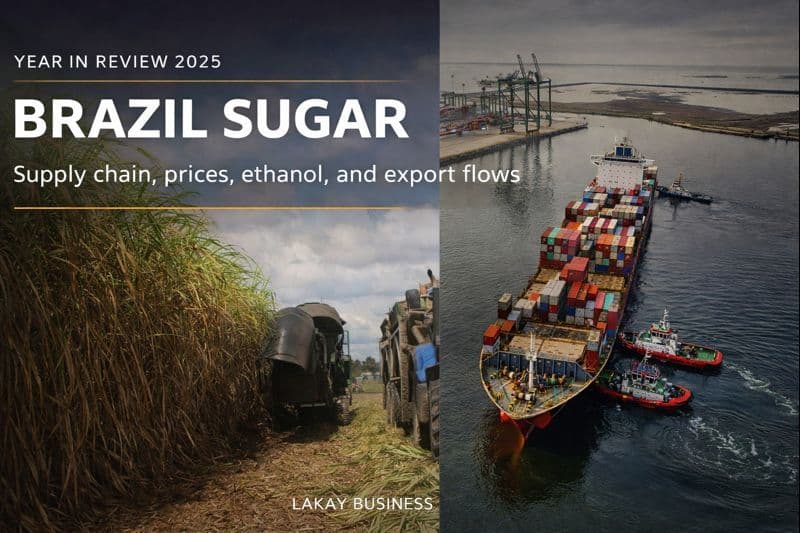
Brazil, the world’s largest sugar producer and , navigated a dynamic 2025 marked by volatile weather, policy shifts, and corporate shake-ups across the sugar supply chain. Coming off a record export campaign in 2024 (thanks in part to India’s export ban), Brazilian mills in 2025 aimed to sustain high output of raw and refined sugar as well as ethanol from sugarcane. The year saw everything from heavy rains and frost scares to trade negotiations and near-record production. Below, we break down month-by-month highlights and then examine top export destinations that bought Brazilian sugar in 2025.

January 2025 – Slow Exports in the Off-Season
Brazil entered 2025 in the inter-crop off-season for its main Center-South cane region. Sugar shipments slowed markedly – January exports were 2.06 million tons, down 35% compared to Jan 2024. Analysts attributed the drop to limited sugar stockpiles after last year’s record exports, as mills had little left to ship before the new harvest. This tight supply helped keep world prices firm around the high-teen cents per pound. In Brazil’s domestic market, sugar prices eased slightly in early January, but the overall weekly balance remained. With Brazil’s inventories drawn down, global buyers looked ahead to the coming harvest for relief.

February 2025 – Prices Surge and Trade Tensions
Global sugar prices jumped in February, reflecting jitters about supply. The UN FAO reported sugar prices up 6.6% month-on-month, citing concerns over tighter 2024/25 global supplies partly due to unfavorable weather in Brazil. (Late 2024 had seen drought and even cane field fires in Brazil’s spring, which raised doubts about the next crop’s yields.) On the trade front, Brazil sparred with the United States over market access. In mid-February, Brazil’s energy minister criticized a proposal by the new U.S. administration to raise tariffs on Brazilian ethanol – calling it “unreasonable” – and demanded the U.S. remove barriers on Brazilian sugar exports. He noted the U.S. imposes an 81% tariff on out-of-quota sugar, effectively capping Brazil’s sales to a mere ~147,000 tons (0.4% of Brazil’s exports) under a small quota. This exchange underscored Brazil’s push for fairer trade, even as its sugar sector benefited from strong world prices.

March 2025 – Harvest Begins Early, Slowly
March saw the first sugarcane crushing of the new 2025/26 crop year, albeit on a limited scale. UNICA (Brazil’s sugar industry group) reported that 19 mills started harvesting early in the first half of March (the official season begins April 1). Total cane crushed in early March was 1.83 million tons, down ~18% from the same period a year prior. With fewer mills running, sugar output fell 19% (to just 52,000 tons in that period), while ethanol production jumped ~20% to 442 million liters – boosted by continued growth in corn ethanol and a higher ethanol mix at some mills. By mid-March, 37 mills were operating (22 processing sugarcane, 5 flex, and 10 dedicated to corn ethanol). Industry officials noted that additional mills were poised to come online later in March, “depending on climate and operational conditions”. In other words, wet weather was a factor – any excessive rain could delay fieldwork. The slow start kept exports low, but global markets remained focused on Brazil’s upcoming big harvest.

April 2025 – Rains Delay Crushing, Big Crop Forecast
April marked the official start of crushing in the Center-South, and it brought both challenges and optimism. On one hand, excess rainfall in late April severely hampered the harvest. Industry data showed sugar production in the second half of April was down ~53–54% compared to the same period the year before. Fields were too wet for harvesting equipment in many areas, causing a nearly 50% drop in cane crush for that fortnight. Despite these early delays, projections for the new crop remained bullish. In late April, Brazil’s crop supply agency Conab released its first forecast calling for 2025/26 sugar production to reach 45.9 million metric tons, a ~4% increase over last year. Notably, Conab expected the total cane crush to actually decline ~2% due to the prior drought’s impact on yields. However, more of the cane would be directed to sugar (versus ethanol) thanks to high global sugar prices. In fact, mills had invested in expanded sugar crystallization capacity and planned a sugar/ethanol mix of roughly 51% sugar to 49% ethanol – up from ~48% sugar the previous season. This strategy, paired with improved field conditions later in the month, aimed to overcome April’s rain setbacks. Toward the end of April, domestic crystal sugar prices and white sugar futures in London both ticked down, reflecting confidence that Brazil’s harvest would accelerate.

May 2025 – Exports Rebound, Still Below Last Year
In May, Brazil’s sugar harvest picked up pace as dryer weather returned. Exports surged to 2.25 million tons for the month, a 45% jump from April’s volumes. This rebound signaled that mills were making up for lost time after the rainy start. However, May’s exports were still nearly 20% lower than the exceptionally high shipments of May 2024. Last year, over 2.8 Mt was shipped in May (a record at the time), whereas this May saw about 2.25 Mt leave Brazilian ports. The year-on-year shortfall was attributed to the earlier weather delays and a slightly smaller cane crop. On the production side, field reports suggested the cane was healthy and sucrose (TRS) levels were average, but simply fewer crushing days in April–May kept cumulative sugar output below the previous year’s pace. Despite that lag, international sugar prices remained elevated in May, hovering in the 18–19 cents/lb range, as traders weighed Brazil’s slower start against strong demand. Internally, Brazil’s currency (Real) was relatively weak, which helped keep Brazilian sugar very competitive on global markets. All eyes were on June and July – peak harvest months – to see if Brazil could catch up to last year’s production rate.

June 2025 – Peak Harvest and Catching Up
June brought mixed conditions but ultimately a strong surge in production. Early in the month, unusual rain events continued to pop up – the first half of June was also damp, holding back some crushing efforts (an uncommon occurrence in Brazil’s dry-season winter). However, by late June the weather cooperated and mills ran at full tilt. Sugar output in the second half of June reached 2.84 million tons for that two-week period – one of the highest biweekly outputs on record. Ethanol production was also massive (1.92 billion liters in the same late-June period), reflecting ample cane availability. Thanks to the June push, Brazil began closing the production gap caused by the slow start. By July 1, cumulative 2025/26 sugar production had reached 12.25 million tons, which is about 14% behind the previous season’s pace (which was 14.29 Mt by the same point in 2024). This was an improvement from the nearly 20% gap a month earlier. Dry, cool weather prevailed through late June, benefiting the crush – though an intense cold snap hit the far south (Paraná) around June 23–25, with frosts reported on some cane fields. Fortunately, those frosts were limited in scope and did not significantly damage the overall crop. In fact, market analysts noted that no major frost impact was expected in 2025, unlike some past years. With the harvest at full speed, sugar prices in New York eased off May’s highs, reflecting expectations of abundant Brazilian supply in the coming months. Notably, Brazil’s state oil company Petrobras cut gasoline prices by ~5.6% in early June , a move aimed at curbing inflation. This reduced gasoline price made ethanol slightly less competitive at the pump, reinforcing mills’ incentive to prioritize sugar production (since ethanol margins were squeezed). By the end of June, Brazil’s sugar sector was firing on all cylinders, intent on reaching a new output record by season’s end.

July 2025 – Strong Output, No Frost Disruption
July is mid-harvest in Center-South Brazil, and 2025’s was running strong. The dry winter weather allowed continuous crushing at or near capacity for most mills. Industry updates indicated the production deficit (vs. last year) narrowed further in July. Some analysts even began predicting that Brazil might match or exceed the prior year’s sugar output, given the high cane allocation to sugar. One looming concern was the risk of frost – late July and early August are the peak frost season for cane fields. There were frost scares in southern growing areas (Paraná and Mato Grosso do Sul) around the final week of July, but thankfully no widespread freeze damage occurred. World sugar markets did react to these frost headlines: in late July, New York raw sugar futures briefly spiked to a two-month high on speculation of potential crop losses. But with no significant frost impact materializing, the rally was short-lived. By this time, another factor was weighing on prices: expectations of a large Indian crop. Early reports from India’s monsoon season were favorable, and traders anticipated India might lift its export restrictions later in the year. This prospect of India’s return to the export market started to pressure global sugar prices. Domestically, Brazilian mills continued churning out sugar and ethanol at high levels. There was sufficient cane supply, albeit with slightly lower yields per hectare than last year (a legacy of 2024’s drought). Overall, July was a month of high throughput and optimism that Brazil would fulfill the year’s ambitious production targets.

August 2025 – Export Surge and Corporate Strains
By August, Brazil’s harvest was beginning to taper in some areas (particularly fields that started early), but overall production remained high. Exports were exceptionally strong in late summer: unofficial data hinted that August sugar shipments might have topped 3 million tons (though not a record, it was one of the highest monthly totals of the year). These export volumes were fueled by demand from Asia and the Middle East and by Brazil’s aggressive sales at competitive prices. However, behind the robust trade figures, the industry’s financial cracks showed through. In mid-August, Raízen S.A. – one of Brazil’s largest sugar/ethanol companies (a joint venture of Cosan and Shell) – announced weak quarterly results that rattled investors. Raízen reported a net loss of R$ 1.8 billion for the Apr–Jun quarter (Q1 of the crop year), and its stock price plunged to all-time lows. Executives cited operational challenges and high debt, noting that lower cane yields and higher costs (due to the previous drought and inflation) had squeezed margins. Raízen even indicated it was open to bringing in a new equity partner to recapitalize the business. This was a striking development, as Raízen is a bellwether for the sector – its struggles suggested many mills faced profit pressure despite lofty sugar prices. Meanwhile, another top producer, Cosan S.A., revealed a net loss of R$1.2 billion in its Q3 2025 results, also blaming reduced sugar output and prices alongside lingering effects of fires and drought on cane fields. These corporate troubles underscored that weather impacts and cost inflation were hitting the bottom line, even as Brazil shipped huge sugar volumes abroad. By end of August, cumulative sugar exports were only slightly behind last year’s record pace, and Brazil had firmly solidified its role as the “supplier of last resort” to the world market in India’s absence.

September 2025 – Harvest Winding Down, Market Shifts
September marked the final stretch of the Center-South harvest. Many mills in São Paulo state and beyond aimed to wrap up cane crushing by the end of the month, slightly earlier than usual, because parts of the cane belt had shorter cycles this year (some cane planted after 2024’s fires wasn’t fully mature, etc.). Sugar production in September naturally declined from the mid-season peak, but overall output for the season was on track to be very large. Unica data through late September suggested the Center-South might produce around 40–41 million tons of sugar in the 2025 season – on par with or a bit above the previous crop year. Globally, market dynamics in September began to pivot. Early in the month, sugar futures hit multi-month highs as traders anticipated Brazil’s looming inter-crop (when exports slow) could tighten supplies. However, by the end of September, bearish factors emerged: India’s government hinted at allowing some exports in the coming months due to a domestic surplus, and Thailand projected a rebound in its upcoming crop. These signals of returning supply from Asia started to put downward pressure on prices. Indeed, sugar that traded above 20 c/lb in early September had fallen back into the mid-teens by late month. For Brazil, the focus was on clearing out remaining cane and maximizing end-of-season sugar crystallization. Logistics ran smoothly – Brazil’s ports had largely overcome earlier congestion issues, and a weak Brazilian real continued to encourage exports. By the close of September, most indicators showed Brazil’s 2025 sugar production would be one of the highest on record, if not the highest, and exports year-to-date were very close to 2024’s record level.

October 2025 – Record-Breaking Exports
October brought a final boom in Brazil’s sugar shipment season. According to trade ministry data, **Brazil’s sugar exports hit an all-time monthly record of 4.2 million tons in October, surpassing the previous record (around 3.93 Mt) set a few years ago. This flood of exports was facilitated by heavy late-season production (including sugar from Brazil’s smaller Northeast region which harvests later in the year) and by strong global demand as importers built inventories. By the end of October, Brazil had exported roughly 30–32 million tons of sugar year-to-date, putting 2025 on pace to roughly match 2024’s full-year record (31.7 Mt in Jan–Oct 2024). The absence of Indian exports all year meant Brazil maintained an outsized ~60–70% share of global sugar trade. Notably, Indonesia and China were the top destinations buying Brazilian sugar in bulk (each well over 3 Mt for the year by this point), followed by markets like the UAE, Nigeria, Bangladesh, and Egypt which all saw elevated imports. The frenzied export activity also highlighted Brazil’s infrastructure: ports like Santos and Paranaguá loaded sugar at high rates, and the logistics held up without major hiccups. On the pricing side, world sugar futures actually eased in October despite Brazil’s export records – a counterintuitive move reflecting the shifting global outlook. Reports in mid-October confirmed that India’s new cane crop was large and the ISO (International Sugar Organization) projected a return to surplus of about +1.6 million tons in the 2025/26 global cycle. Thus, as Brazil was shipping record amounts, traders believed the supply tightness was peaking and relief was on the horizon. Internally, Brazilian mills were pleased with the season’s outcome: high volumes and decent (if volatile) prices. Most Center-South mills concluded crushing by late October, and attention turned to maintenance and off-season ethanol production from corn.

November 2025 – Season Wrap-Up and Outlook
By November, the Center-South sugar harvest was essentially finished – a bit earlier than usual, as many mills had no cane left to crush after an intense season. Industry figures showed that 2025’s sugar production ended very close to initial targets. In early November, Conab revised its forecast upwardslightly, estimating 45.0 million tons of sugar for 2025/26, up from 44.5 Mt previously. If realized, that would be just shy of Brazil’s all-time record (set in 2023) and a testament to the higher sugar mix. UNICA’s final tally for Center-South production through November confirmed output was about 1.1% higher year-on-year (39.9 Mt vs ~39.5 Mt). This was a remarkable recovery from the spring delays. Crucially, the sugar mix reached ~51.1% of cane (versus 48.3% last year), meaning mills successfully maximized sugar yields. Ethanol output for the season was correspondingly down ~4% according to Conab, despite an uptick in corn ethanol. In the international arena, November brought confirmation of a changing tide: the ISO announced that after a deficit in 2024/25, the world sugar market would swing to a surplus in 2025/26 (on the order of +1.6–2.0 Mt). This surplus is driven by production growth in Asia – notably a projected ~19% jump in India’s sugar output (to ~31–32 Mt) and recovery in Thailand and Pakistan. With Brazil’s crop in the barn, global focus shifted to these Asian crops and to Brazil’s upcoming offseason. Brazilian officials noted that domestic sugar inventories were very low after the export push, which could keep the local market firm until the next harvest. Nonetheless, by late November sugar prices had drifted down into the mid-teens (cents per lb), and some speculative funds turned net short on sugar for the first time in over a year, anticipating ample supply ahead. Brazilian sugar/ethanol companies, meanwhile, began strategizing for 2026 – many will invest in cane replanting (thanks to good rains in late 2025) and cost-cutting measures, aiming to improve profitability after a tough financial year.

December 2025 – Offseason Begins, Global Trends
December is the heart of the intercrop period in Center-South Brazil, so activity was relatively quiet. Mills focused on maintenance and planting. The North-Northeast region was still harvesting (their crop runs roughly September–March) but NNE produces only ~10% of Brazil’s cane. Brazil’s sugar exports in December dropped to minimal levels, as usual, after the bulk of the crop was shipped earlier. On the global stage, sugar prices fell to their lows of the year – by end of December, raw sugar #11 was trading around 14.8 US¢/lb (down from nearly 19¢ in January)trading. Several factors drove this decline: India’s government officially authorized 1.5 million tons of sugar exports for 2025/26 (a reversal from the prior year’s ban) amid an expected domestic surplus; Thailand forecasted a ~5% larger crop; and even Brazil’s outlook for 2026 suggested slightly less sugar (as some cane areas recover from replanting and past stress). The Brazilian real also strengthened modestly in late year, reducing exporters’ local currency revenue and squeezing mills’ margins further. Still, from a full-year perspective, Brazil’s sugar sector had an impressive run in 2025 – it managed to produce near-record sugar, expand ethanol from corn, and supply world markets when needed, all despite weather hiccups and financial strains. As the year closed, market analysts predicted Brazil’s 2026 sugar production may dip slightly (due to heavy replanting and the need to rejuvenate some fields), but the country’s strategic investments in capacity mean it will remain the cornerstone of global sugar supply. In policy news, Brazil signaled it will pursue higher ethanol blending (E30) in gasoline in coming years, which could alter the sugar/ethanol mix beyond 2025. For now, however, the industry is content to catch its breath after a whirlwind year.

Brazil’s 2025 Sugar Exports: Top Markets and Trends
Brazil’s dominance in 2025’s sugar trade was evident not only in volumes but in the diversity of destinations. With India largely absent as an exporter, Brazilian sugar flowed to over 100 countries. The largest buyers were in Asia and the Middle East:
- China: China was a leading importer of Brazilian sugar in 2025, as it has been for several years. By August, China alone accounted for about 19% of Brazil’s sugar exports (≈2.7 Mt). For the full year, Chinese purchases are estimated around 3–4 million tons, making China a top destination as it seeks to meet domestic demand and refill state reserves.
- Indonesia: Indonesia’s imports surged with India out of the market. In fact, in 2024 Indonesia overtook China as the single largest destination for Brazilian sugar, and it remained among the top in 2025. Through September 2024, Indonesia had taken 2.6 Mt from Brazil; in 2025 it likely imported a similar or even higher volume (around 3 million tons). Indonesian refiners rely on Brazilian raw sugar, and they nearly tripled their uptake in 2024 vs 2023 – a high level that continued into 2025.
- India: In a twist, India itself became a notable importer of Brazilian sugar in this period. Facing two years of below-par production and high domestic prices, India imported Brazilian raws to cover shortages. From January–September 2024 India imported 2.2 Mt, and in 2025 it remained a major buyer. By August 2025, India had imported over 1.1 Mt of Brazilian sugar for the year. These imports helped cool India’s domestic market. (India’s import demand tapered after its new cane harvest began in October, and with a better 2025/26 crop, it plans to return to exporting in 2026.)
- Middle East & North Africa: Several countries in MENA sharply increased purchases from Brazil. Notably, the UAE (United Arab Emirates) almost tripled its Brazilian sugar imports in Jan–Sept 2024 to ~2.1 Mt, and it likely imported similar amounts in 2025. The UAE acts as a regional refining hub, so some of that sugar is re-exported as refined product. Egypt also more than doubled its takings to ~1.6 Mt in the first nine months of 2024 and continued high imports in 2025, benefiting from favorable terms and need for affordable supply. Bangladesh and Nigeria are two other significant markets – each consistently buys Brazilian sugar (often white sugar in bags for Bangladesh, and raws for Nigerian refineries). Nigeria’s imports climbed in 2025 (e.g. ~0.74 Mt in Apr–Aug period) as it sought to fill a gap left by lower Thai export. Algeria and Morocco are noteworthy in North Africa, though they import slightly less; Algeria received around 0.9 Mt in Apr–Aug 2025.
- Other Asia: Countries like Malaysia, Iraq, Yemen, Saudi Arabia, and Iran also source most of their sugar from Brazil. While individually their volumes are smaller, together “Others” accounted for a large share (over 5 Mt in Apr–Aug 2025 data). This underscores how Brazil’s exports reach virtually every region.
In summary, Brazil’s top export destinations in 2025 were China and Indonesia (each on the order of 3 million+ tons), followed by India (~1–2 Mt), and then a cohort including the UAE, Egypt, Bangladesh, Nigeria, Algeria, and Morocco (each importing on the order of 0.5–1.5 Mt). Many of these countries dramatically increased their Brazilian sugar purchases compared to prior years, compensating for the absence of Indian exports. Brazil’s ability to supply such a broad market is supported by its efficient logistics and large trade houses operating in the country. It’s worth noting that Brazil’s exports in raw form (VHP sugar) far exceed refined sugar – roughly 88% raw vs 12% white by ton – as many importing nations have refining capacity. The United States is a minor buyer (due to tariff quotas), taking well under 1% of Brazil’s exports.
In 2025, Brazil solidified its role as the world’s sugar bowl, supplying record volumes to a wide array of countries. The year’s journey – month by month – showed the industry’s resilience in the face of weather and market challenges. As Brazil moves into 2026, it will leverage that experience to maintain its sugar powerhouse status, even as global conditions evolve.