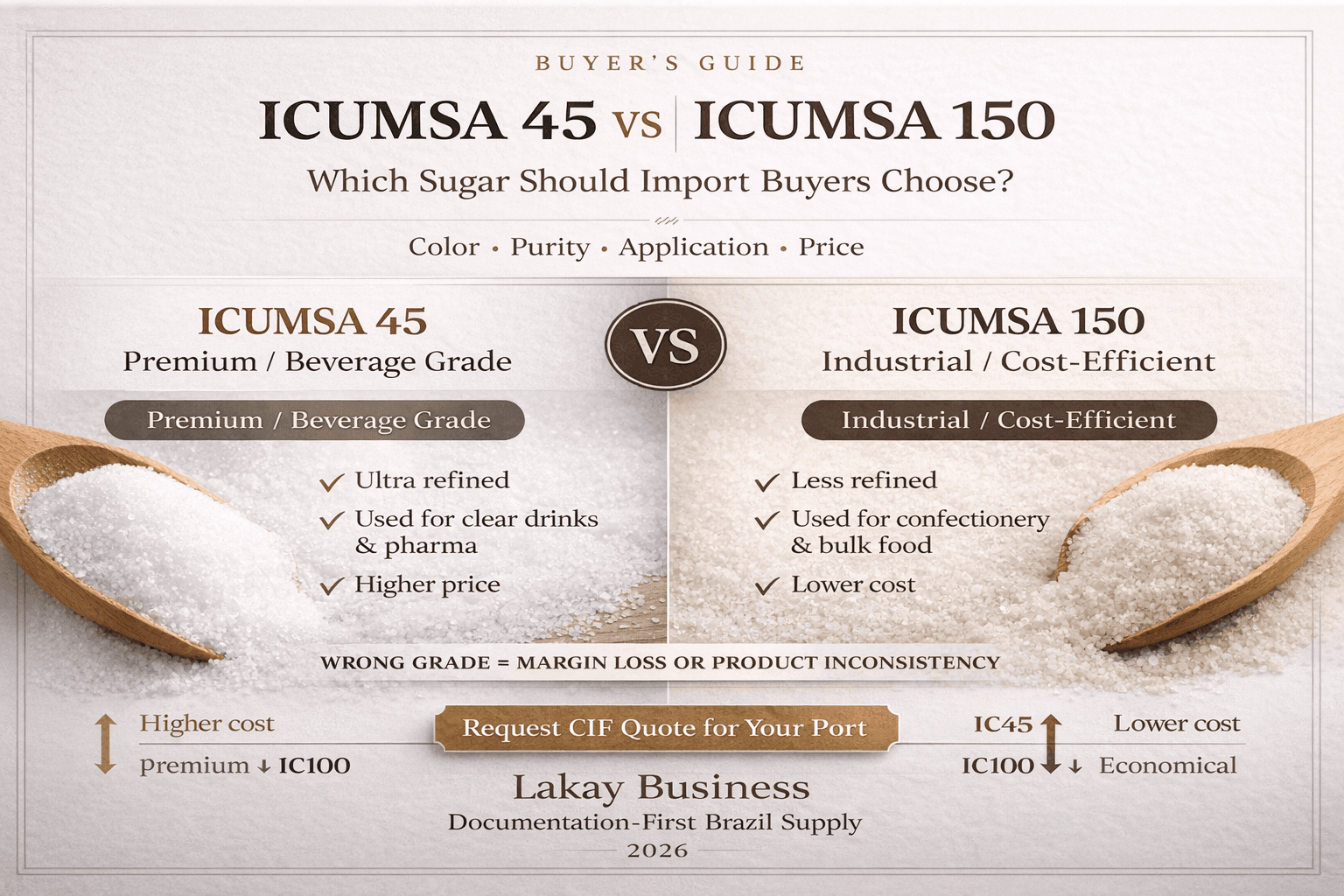
If you're evaluating sugar offers from Brazil, you've almost certainly seen both ICUMSA 45 and ICUMSA 150 appear in trade discussions. They're the two most commonly referenced refined sugar grades in international commerce but they are not interchangeable, and they're rarely bought for exactly the same reasons.
The difference between them goes beyond color. It touches buyer perception, end-market expectations, resale positioning, landed cost logic, and even how your banking documents hold up under review. Choosing between these two grades is a commercial decision, not just a product one.
This article breaks down what separates ICUMSA 45 from ICUMSA 150, and what import buyers should actually consider before locking in a contract.

What Does ICUMSA Mean in Sugar Trade?
ICUMSA stands for the International Commission for Uniform Methods of Sugar Analysis. In practice, it's the standardized reference system used to express the color and purity level of sugar in international trade.
The lower the ICUMSA number, the whiter and more refined the sugar. The higher the number, the more residual color is present. This doesn't necessarily mean one is "better" it means they serve different commercial purposes and attract different buyer profiles.
For importers, the ICUMSA value is one of the first specification points confirmed in any sugar contract, and it directly influences pricing, buyer expectations, and downstream market fit.
What Is ICUMSA 45 Sugar?

ICUMSA 45 is the most refined white sugar grade widely traded on the international market. It's characterized by a bright white appearance, very low color value, and tight specification tolerances that meet the expectations of markets where presentation and product consistency matter.
We covered ICUMSA 45 in detail in our earlier article, What Is ICUMSA 45 Sugar?, including its typical specifications, common origins, and what serious buyers should look for before accepting an offer. If you haven't read that piece, it's a useful starting point.
In short: ICUMSA 45 is the grade that tends to carry the highest buyer expectations in terms of both product quality and trade execution.
What Is ICUMSA 150 Sugar?

ICUMSA 150, often referred to in trade as white crystal sugar or VHP-adjacent refined sugar, occupies a different commercial lane. It's a refined product, but with a higher permissible color value, which means it may carry a slight off-white or light golden tint depending on the production batch.
This grade is commonly positioned for markets where ultra-white appearance is not the primary purchasing criterion or where the sugar is destined for industrial processing, blending, or local retail channels with different visual standards.
ICUMSA 150 is not raw sugar. It's a refined grade that simply sits at a different point on the color and processing spectrum compared to ICUMSA 45. Misunderstanding this distinction has cost more than one buyer a deal that didn't match their end-market requirements.
ICUMSA 45 vs ICUMSA 150: The Main Differences

This is where the comparison matters most for procurement decisions.
Color and Visual Appearance ICUMSA 45 is bright white. ICUMSA 150 may present as off-white or slightly cream-toned. In markets where shelf appearance drives retail decisions, this visual gap can be significant. In industrial or processing contexts, it may be irrelevant.
Refining Level ICUMSA 45 undergoes a more intensive refining process to achieve its low color value. ICUMSA 150 is refined but to a lesser degree, which also affects production cost at origin and, consequently, FOB pricing.
Buyer Perception In many destination markets — particularly in the Middle East, parts of Africa, and Southeast Asia — ICUMSA 45 is perceived as the premium import-grade sugar. ICUMSA 150, while commercially viable, may face resistance in markets conditioned to expect a whiter product on retail shelves.
Commercial Positioning ICUMSA 45 is typically positioned as a direct retail or high-visibility food-service product. ICUMSA 150 is more commonly directed toward industrial buyers, processors, or retail markets with different color expectations.
Downstream Use Cases Buyers reselling into packaged consumer channels often prefer ICUMSA 45. Buyers supplying beverage manufacturers, confectionery plants, or local blending operations may find ICUMSA 150 perfectly adequate — and more cost-efficient.
Resale Attractiveness In markets where imported sugar competes on appearance, ICUMSA 45 tends to move faster through distribution. ICUMSA 150 may require stronger pricing incentives or a well-established buyer network to move at the same pace.
Pricing Logic ICUMSA 45 generally commands a premium over ICUMSA 150, reflecting the additional refining cost and the perception advantage. However, the spread between the two grades is not fixed — it fluctuates with market conditions, origin availability, and freight dynamics.
Destination Market Expectations This is often the deciding factor. Some markets have regulatory or buyer-standard expectations that effectively require ICUMSA 45. Others are more flexible and commercially favor ICUMSA 150 for its cost advantage. Knowing your destination market's norm is essential before committing to a grade.
Which Buyers Usually Prefer ICUMSA 45?

Buyers who lean toward ICUMSA 45 typically serve markets where the visual standard for sugar is non-negotiable. This includes importers supplying supermarket chains, branded repackaging operations, and hospitality or food-service distributors where product presentation is part of the value chain.
These buyers also tend to face tighter resale scrutiny, meaning their downstream customers expect consistency in color, grain size, and packaging appearance. For them, the premium paid at origin is justified by smoother distribution and fewer complaints at the point of sale.
Markets in the Middle East, North Africa, and parts of East and West Africa are common destinations where ICUMSA 45 is the expected standard for imported refined sugar.
Which Buyers Usually Prefer ICUMSA 150?

ICUMSA 150 tends to attract buyers whose purchasing logic is built around cost efficiency, volume, and functional adequacy rather than retail presentation.
This includes industrial processors — think confectionery, beverages, bakery — where the sugar is an input ingredient, not a shelf product. It also includes importers supplying markets where the local standard accommodates a broader color range, or where domestic sugar production already conditions buyers to accept non-white refined grades.
Some trading firms also prefer ICUMSA 150 for tender-based procurement, where the specification allows it and landed cost is the primary evaluation criterion.
Price Is Not the Only Buying Factor
It's tempting to frame the ICUMSA 45 vs ICUMSA 150 decision purely around price per metric ton. But any experienced importer knows that landed cost — and deal viability — depend on far more than FOB or CIF headline numbers.
Factors that shape the real cost and risk of a sugar import include tonnage and minimum order requirements, destination port logistics, freight rates and vessel availability, packaging format, Incoterms and shipment structure, payment terms and instrument type, prevailing market conditions at the time of contracting, and the documentary package required for customs clearance and banking compliance.
A lower-priced ICUMSA 150 offer with unclear documentation or untested payment terms can end up costing more than a well-structured ICUMSA 45 contract with clean paperwork and bankable instruments.
What Import Buyers Should Verify Before Signing a Sugar Contract

Regardless of which grade you're buying, contract discipline protects your capital and your timeline. Before signing, experienced buyers confirm:
Exact product specification. Not just "ICUMSA 45" or "ICUMSA 150" in the header — but the full spec sheet, including polarization, moisture, ash content, grain size, and color value range.
Origin and shipment details. Confirmed loading port, estimated laycan, vessel nomination terms, and any origin-specific export documentation.
Inspection terms. Is SGS or equivalent inspection confirmed at loading? Who bears the cost? What happens if results fall outside specification?
Certificate of Analysis. A COA issued in the supplier's name — not a recycled third-party document — is a basic indicator of supply-chain accountability.
Contract clarity. Performance bonds, penalty clauses, force majeure terms, and dispute resolution mechanisms should all be spelled out before execution begins.
Payment structure. Whether the deal is structured around a DLC, SBLC, or other instrument, the payment flow must be bank-friendly and clearly documented. Ambiguity here is one of the most common deal-breakers in sugar trade.
Document package for banking. If your bank can't process the documents cleanly, the deal stalls. A complete, consistent document set — including commercial invoice, packing list, bill of lading, COA, SGS report, and phytosanitary certificate — should be part of every serious offer.
Avoid buying on headline price alone. The cheapest offer with missing documentation or vague shipment terms is rarely the cheapest deal by the time it lands.
Which Grade Is Better for Your Market?
There is no universal answer. ICUMSA 45 is not inherently "better" than ICUMSA 150, and ICUMSA 150 is not simply a budget substitute. Each grade serves a different commercial purpose, and the right choice depends on your end market, your customer base, your pricing model, and how your operation handles execution risk.
The better grade is the one that fits your buyer's expectations, your margin structure, and your confidence in the supply chain behind it.
Request a Quote for Brazil Sugar Supply

Lakay Business supplies Brazil-origin sugar with a documentation-first approach :COA in our name, SGS at load, and bank-friendly payment structures built for serious import operations.
Whether you're sourcing ICUMSA 45 or evaluating ICUMSA 150 for your market, we can provide a quote based on your tonnage, destination, shipment terms, and documentation requirements.
Contact us to discuss your next sugar import with a supplier that prioritizes execution discipline and buyer confidence.
Methodology & Disclaimer
This analysis is prepared by the LAKAY BUSINESS Commodity Intelligence Desk using publicly available data from official Brazilian government agencies (Secex), industry associations (UNICA), international organizations (ISO), and established commodity research firms. All figures are attributed to their original sources and verified against multiple references where possible. Where data could not be confirmed, it is explicitly noted. This report is intended for informational purposes only and does not constitute trading advice. Past performance and market data do not guarantee future results.
Stay ahead of the sugar market
Get verified commodity intelligence, trade data, and procurement insights delivered to your feed. No speculation — only sourced analysis.